


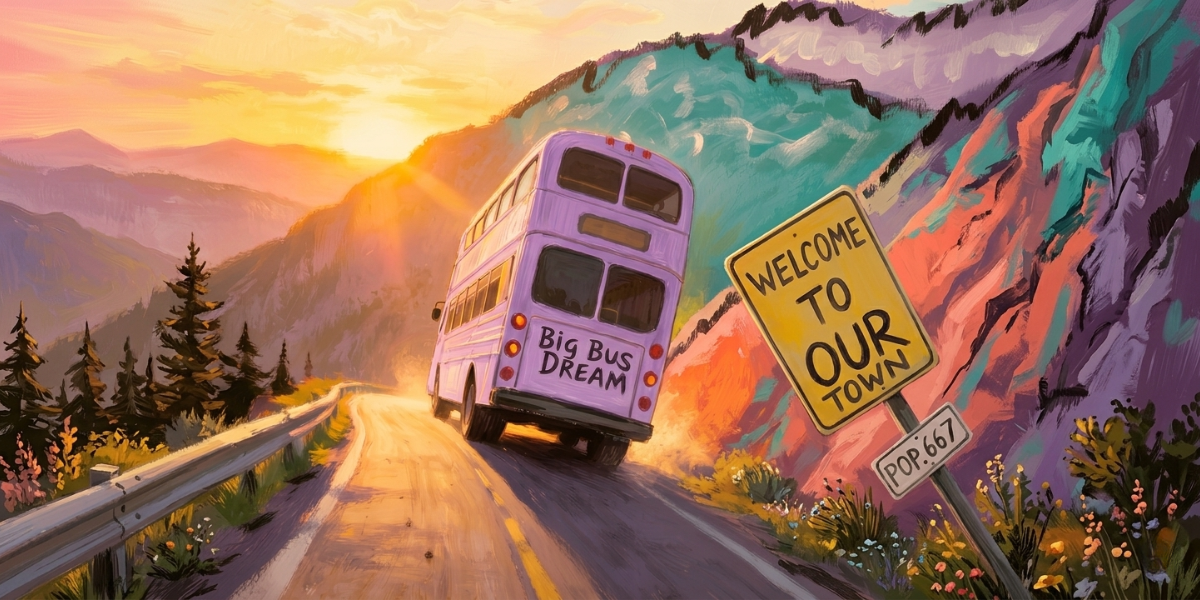
Michael Shannon’s Passionate Decay rejects polished conformity in favor of honesty, emotional risk, and a body of work built to outlast the moment.
Most music today is given only a few seconds to prove itself.
A listener scrolls, clicks, samples, and moves on. Songs compete with videos, headlines, notifications, and millions of other fragments demanding attention. The market rewards immediacy, familiarity, and anything that fits neatly into an existing category.
Big Bus Dream was not created to fit neatly anywhere.
Led by founder and artist Michael Shannon, the project asks something increasingly unusual of its audience: stay long enough to feel something.
That request sits at the center of Passionate Decay, a 12-song album built on emotional honesty, imperfection, and the refusal to smooth away every difficult edge. Its featured track, “I’m Not Alright,” does not sound designed to disappear into a playlist. It is intended to interrupt one.
For Shannon, that interruption is the point.
He is not trying to make background music. He is creating work that asks listeners to stop, look, listen, and think.
Why Big Bus Dream Sounds Different
Big Bus Dream exists outside the formulas dominating much of the current market.
It is not trying to imitate pop trends, compete with K-pop spectacle, or hide every flaw beneath layers of production. Shannon’s music leaves room for roughness, tension, humor, regret, and emotional contradiction.
Those qualities are not defects waiting to be corrected. They are part of the identity of the work.
In a culture where artists are often encouraged to polish everything until it becomes universally acceptable, Big Bus Dream takes a risk by remaining specific. The songs sound lived in. They carry the weight of experience rather than the shine of a manufactured persona.
That difference matters because listeners are surrounded by content engineered to be consumed quickly and forgotten just as fast.
Big Bus Dream offers the opposite.
The music rewards attention. A first listen may reveal the emotion. A second may expose the craft. A later return may uncover a lyric or sound that suddenly feels personal.
That slow recognition is part of what separates the project from the daily noise.
“I’m Not Alright” and the Value of Honesty
There is a moment in “I’m Not Alright” when the song stops feeling like a performance and begins to feel like an admission.
It does not offer a polished solution or pretend that every difficult feeling can be resolved in a chorus. Instead, it gives the listener something more useful: recognition.
For anyone who has felt overwhelmed, disconnected, disappointed, or unseen, the song offers company without trying to explain the experience away.
Shannon’s approach to the track is simple.
“Listen to it, then write what you feel,” he says.
That instruction reflects his trust in the music. He does not want to tell listeners what they are supposed to think. He wants the song to create its own response.
This is where Big Bus Dream earns attention. It does not demand that people care because a campaign says they should. It gives them a reason to care through the work itself.
The song’s honesty becomes the invitation.
Why Offer the Album as a Free Download
Offering Passionate Decay as a free download is not a sign that the music lacks value.
It is a deliberate decision to remove the barrier between the listener and the experience.
Shannon understands the challenge facing independent artists. People may visit a website, stream a track, or watch a video, yet hesitate when asked to pay for a download or exchange an email address before they have formed a connection.
His response is to let the music come first.
The free download gives listeners the opportunity to enter the full world of Passionate Decay without being asked to make an immediate purchase. It reflects confidence in the body of work and in the possibility that a real connection will matter more than a forced transaction.
The album is not being presented as disposable content simply because it is accessible.
It is being offered as an invitation.
Shannon is betting that when listeners hear the songs in full, explore the lyrics, watch the videos, and spend time with the project, some will choose to stay connected because the work gave them a reason.
That distinction is important.
The goal is not to make the music feel cheap. The goal is to make it easier to discover.
A Creative World, Not Just a Single Release
The official Big Bus Dream website expands the experience beyond the album itself.
Visitors can explore videos, read full lyrics, browse photography and artwork, and listen through an on-page music player. The site gives context to the songs without overexplaining them and allows listeners to move through Shannon’s work at their own pace.
The catalog also has a history beyond Passionate Decay.
The song “No Valentine” was featured in the film My Life as Abraham Lincoln, demonstrating the cinematic quality present in Shannon’s writing. Big Bus Dream has also received coverage from music publications, maintains a presence on Pandora, and has continued building a body of independent work across multiple releases.
These details matter because Passionate Decay is not a one-week promotion or an isolated experiment.
It belongs to a larger creative archive.
Shannon has spent years building songs, images, videos, and ideas that reflect his perspective. Together, they form a record of a life in music that was created without waiting for permission from the mainstream.
The Merchandise as a Collector’s Piece
The Big Bus Dream merchandise is another part of that archive.
The shirts are not intended to function as generic promotional products. They are designed as collector items connected to the music, imagery, and history of the project.
Shannon is preparing to add a second shirt to the merchandise collection, expanding the physical pieces associated with Big Bus Dream. The pricing reflects the realities of producing quality apparel without the lower costs available through massive bulk printing.
That context is important.
Independent merchandise cannot always compete with mass-market pricing because it is not produced on the same scale. Its value comes from something different: limited availability, direct connection to the artist, and its place within the history of the work.
For listeners who connect deeply with Big Bus Dream, a shirt is not simply clothing. It is a tangible piece of the project and a way to carry part of its story forward.
The current offer also gives listeners who download the album a twenty percent discount on a collector T-shirt, connecting the music and merchandise without turning either into a disposable promotion.
Music Built as a Legacy
There is urgency behind the current chapter of Big Bus Dream.
Shannon expects that he may begin packing up the project within the next year. That possibility gives Passionate Decay, the website, the videos, the artwork, and the merchandise an added significance.
This is not merely another release in an endless cycle of content.
It is part of a legacy.
The songs represent years of independent thought, creative risk, and a determination to make work that sounds like itself rather than whatever the market currently rewards.
Legacy does not require mass popularity to matter. It requires the work to remain honest enough that someone can discover it later and understand what the artist was trying to preserve.
Big Bus Dream preserves a willingness to be emotionally direct, musically unconventional, and unapologetically outside the mainstream.
It also preserves Shannon’s belief that listeners are capable of more than passive consumption.
They can stop.
They can listen.
They can decide for themselves whether the music means something.
Why It Deserves the Time
Big Bus Dream is not different merely because it avoids current trends.
It is different because it treats attention as something worth earning.
The songs do not rely on spectacle, perfect surfaces, or an image calculated to appeal to everyone. They offer personality, friction, emotional weight, and a point of view.
For listeners exhausted by music that feels interchangeable, that may be reason enough to stay beyond the first ten seconds.
For those who connect with the work, Passionate Decay offers more than a stream. It offers a complete album, visual material, lyrics, videos, merchandise, and a direct path into the larger Big Bus Dream catalog.
The music is available freely because Shannon wants the decision to begin with listening.
The merchandise exists because the work has a physical history worth preserving.
The project matters because it represents an artist choosing honesty over conformity and legacy over noise.
Start with “I’m Not Alright.” Listen without skipping ahead. Then explore Passionate Decay and decide what it makes you feel.
The full album is available through the official Big Bus Dream website. Listeners can also watch project videos on YouTube, follow updates on Instagram, and explore related music through the 4th Ward Records Facebook page.